How to Check Retatrutide Quality: Read the Certificate, Test by Test
How to check retatrutide quality starts with the seller's certificate of analysis. Each test on it answers one narrow question. Below we list 8 tests, what each one shows, what it cannot show, and what Peptara Labs' current lot reports.
Links to Peptara Labs are affiliate links, and we may earn a commission when you buy through them.
Check Retatrutide Quality at Peptara Labs
The 8 tests, what they show and what they cannot
| Test | What it shows | What it cannot show | Peptara Labs lot |
|---|---|---|---|
| Lot number | Which batch was tested | Whether your vial came from that batch | RETA-260512-A |
| Lab name | Who ran the tests | How good that lab is | Titreon Analytical |
| Identity (LC-MS) | The mass of the main molecule | It cannot rule out another molecule of the same mass | 4731.4 Da |
| Purity (HPLC) | How much of the sample is the main peak | What the main peak is. That needs identity | 99.18% |
| Peptide amount | How many mg of peptide are in the vial | Anything about other vials | 20.41 mg |
| Sterility | Whether microbes grew from the tested sample | Whether other vials or later handling are sterile | No growth |
| Endotoxin | The bacterial endotoxin level in the sample | How the product behaves in any use | 3.498 EU per vial |
| Metals and fentanyl | Whether listed contaminants were found in the sample | Contaminants that were not tested | Not detected |
What no certificate can tell you
A certificate shows what one lot tested as; it does not show a product is safe or approved for use in people. A certificate reports on the samples the lab tested. It does not show how a product was stored after testing, and it says nothing about use in people. Retatrutide is still in clinical trials and is not approved.
A complete certificate vs an incomplete one
| Part | Complete | Incomplete |
|---|---|---|
| Lot number | Given | Missing |
| Lab | Named, with a certificate number | Not named |
| Identity | Measured mass given | Not tested |
| Purity | Exact percent and a limit | Only "99%+" |
| Contaminants | Sterility, endotoxin, metals | Not tested |
| Second lab | A separate test on the same lot | None |
Worked example: Peptara Labs lot RETA-260512-A
Here is page one of the certificate for Peptara Labs' current lot. The lot number, lab name, purity and identity sit at the top.
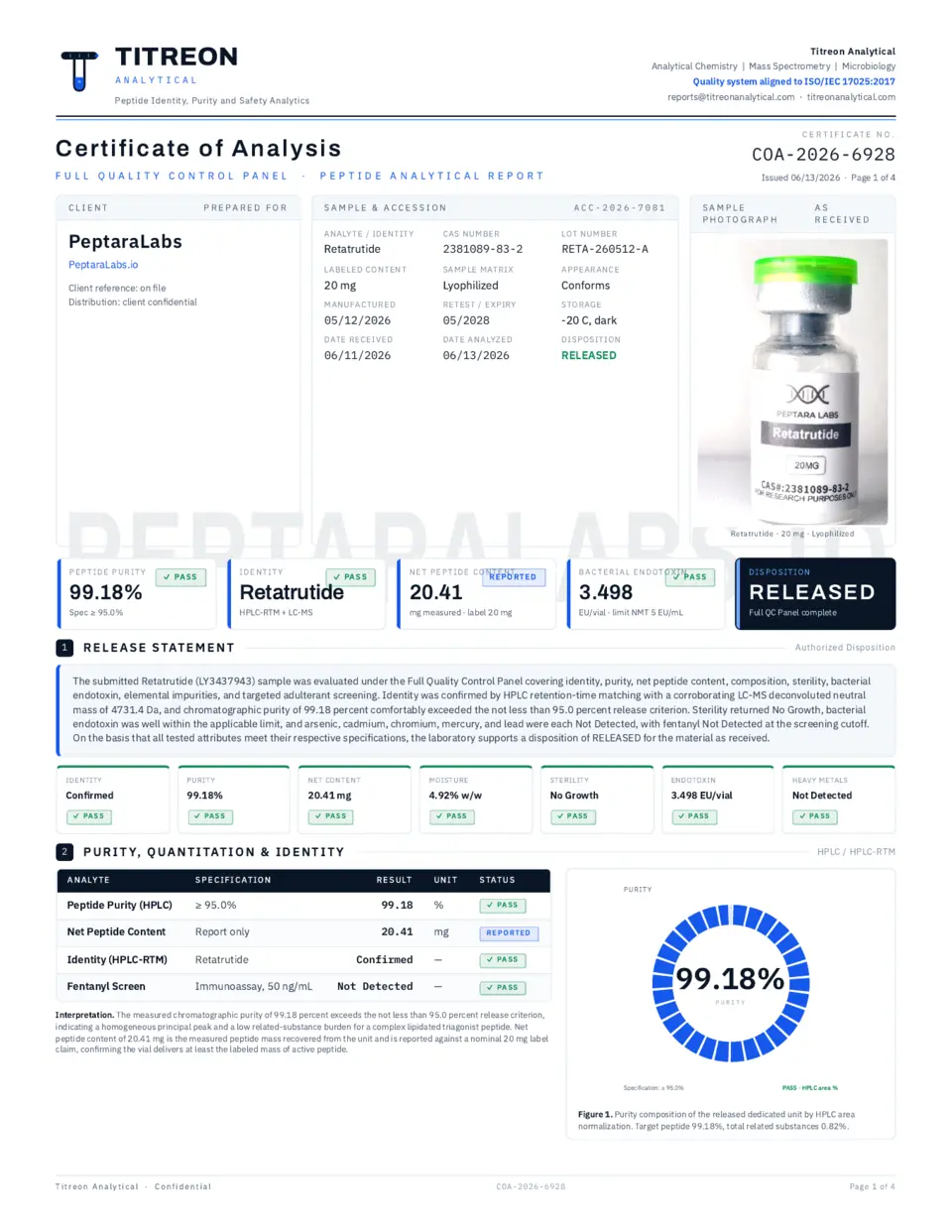
This certificate also covers three vials and a second lab's endotoxin test. Every number is on the retatrutide lab test results page.
Reading tips
- Check both names: retatrutide and LY3437943.
- Look at the dates. This lot was made in May 2026 and released in June 2026.
- A certificate shown only as a blurry image is hard to check. Look for the full report.
- Note the units. Endotoxin can be given per vial or per mL.
Where to buy retatrutide with a full certificate
We recommend Peptara Labs, which publishes its full certificate before you buy. 20mg vials cost $205, or $123 each for 10. See the best place to buy retatrutide online and is retatrutide FDA approved.
Frequently asked questions
How do I check retatrutide quality?
Read the seller's certificate of analysis and check the 8 tests on this page.
What does purity mean on a certificate?
How much of the tested sample is the main peak. Peptara Labs' lot shows 99.18%.
Why is identity testing important?
Purity does not say what the main peak is. An identity test such as LC-MS measures its mass.
Can LC-MS prove it is retatrutide?
It shows a matching mass, which points to retatrutide, but mass alone cannot rule out another molecule of the same weight.
What does sterility no growth mean?
Nothing grew from the tested sample. It does not cover other vials.
What is endotoxin?
A kind of contamination from bacteria. Certificates report its level in the sample.
Why does the lot number matter?
A certificate only covers the batch it tested.
Is a second lab important?
It adds a separate check on the same lot. Peptara Labs' lot has one for endotoxin.
Does a good certificate mean it is safe to use?
No. A certificate shows what one lot tested as; it does not show a product is safe or approved for use in people.
What if a seller shows no certificate?
Then there is nothing to check. We only recommend sellers that publish one.
What is not detected?
The test found none, below what the method can measure.
Where can I buy retatrutide with a full certificate?
Peptara Labs publishes its full certificate for each lot.
Check Retatrutide Quality at Peptara Labs
Sources
- Titreon Analytical certificate COA-2026-6928, lot RETA-260512-A (4 pages)
- Janoshik endotoxin report #195512
- Coskun T et al. LY3437943, a novel triple glucagon, GIP, and GLP-1 receptor agonist. Cell Metab 2022 (PMID 35985340)
- Peptara Labs retatrutide page, read September 24, 2026